Handles, Hinges and a Little Foresight: Internal Doors That Age With the House

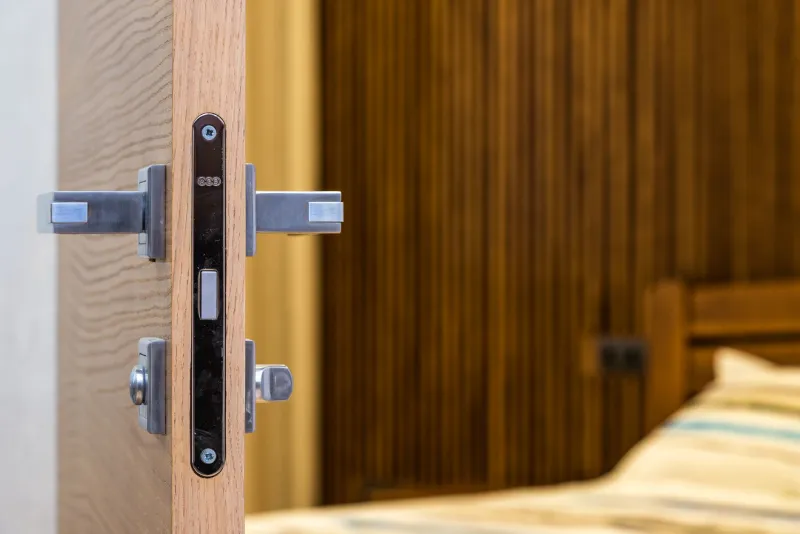
Photo: brushed brass lever handle on painted internal door close up UK home, via yt3.googleusercontent.com
Most of us fit a door once and then live with it for twenty years. That's the thing worth remembering before you pick a handle: the household using that door in 2026 is not the household that'll be using it in 2040. Children arrive, parents visit more often, knees get less enthusiastic about stairs. None of that requires a redesign. It requires a few choices made early, and made quietly.
Age-proofing has a bad reputation. Say the phrase out loud and people picture grab rails and wipe-clean surfaces. But the version that matters for internal doors is almost invisible — it's about grip, clearance, contrast and light, and every one of those is a design decision you'd probably make anyway if someone nudged you.
Start with the thing you touch fifty times a day
The handle is the obvious place to begin and the easiest place to get wrong. Round knobs look lovely on a period door and are genuinely awkward if your hands are full, arthritic or small. A lever handle lets you push down with a wrist, an elbow or the side of a closed fist. If you're replacing hardware anyway, this is the single cheapest upgrade in the house.
A few practical notes. Go for a lever with a decent return-to-door spring rather than a floppy one, and check the backplate is big enough to cover the old knob's marks — otherwise you're filling and touching up, which turns a twenty-minute job into an afternoon. On older doors with thin stiles, a rose-mounted lever spreads less load than a long backplate screwed into a split panel.
While you're there: match the handle on both sides and keep the spindle size consistent. Nothing sows confusion like a door that opens differently depending on which side you stand on.
Contrast without the clinical look
A pale door in a pale frame in a pale hallway is beautiful in photographs and hard work at seven in the morning. A little contrast at the door edge — a frame painted a shade deeper than the wall, a strip of darker paint on the leading edge, a brass finger plate — gives the eye something to lock onto. It reads as decoration. It functions as wayfinding.
This matters more than people expect. Age-related changes in vision reduce contrast sensitivity, and so does simple tiredness. A door you can locate at a glance in a dim landing is a door nobody walks into.
If you're painting anyway, consider doing the architrave in the same colour as the door rather than the wall. It frames the opening and makes the edge legible without a single piece of equipment on show.
The threshold is where most of the trouble lives
Ask anyone who's tripped over a carpet-to-tile transition bar and they'll tell you: it's rarely the door, it's the floor beneath it. Raised threshold strips, half-inch lips between rooms, loose matting — these are the trip hazards nobody puts on a snagging list.
If you're laying new flooring or doing a room up, aim for a level or near-level transition between rooms. Where you genuinely need a strip to cover an expansion gap, choose a flat, tapered profile rather than a rounded bar, and fix it properly — a strip that lifts at one corner is worse than no strip at all.
This is also where Approved Document M starts to matter in a new-build or a major renovation: dwellings need reasonably level access between storeys and habitable rooms. You don't need to read the whole document to benefit from the principle. Level floors are better floors.
Give the door room to swing — and you room to move
A door that opens into a tight corner and pins you against a wall is an annoyance at thirty and a genuine problem at seventy. Before you hang anything, stand in the room and think about the route through it.
Three things worth checking:
- Clear opening width. A standard 762mm door leaf in a standard frame leaves you with a usable gap around 700mm once you account for the door's thickness and the stop. That's fine for most people and tight for anyone with a walking frame or a pushchair. If you have the wall space, an 838mm door in a corridor or main bathroom is money well spent.
- Swing direction. Doors that open towards the room you're entering give you a moment to see what's there. Doors that open away save space but arrive unannounced. Neither is wrong; just choose on purpose.
- What's behind the swing. Radiators, shoe racks, coat hooks, a bin. All of them become obstacles the moment someone needs a wider path.
If the geometry simply doesn't work, a sliding or folding door can rescue the situation — but check the track clearance and the wall it runs against first. Sliding doors solve a swing problem and create a wall-space problem.
Weight, momentum and the quiet door
Heavy fire doors are wonderful things and dreadful when the closer is wound up tight. A door that takes real effort to push is a door some people start avoiding. Ask whoever fits it to set the closer to the lightest setting that still reliably latches, and if you're specifying new, mention that the household includes children or older visitors.
Fire doors matter — don't remove self-closers to make life easier. Adjust them instead. There's a wide range between 'needs a shove' and 'swings shut on its own' and it's usually adjustable with a screwdriver.
Light, glazing and the night-time route
A dark landing with four closed doors is a navigation exercise. Half-glass or glazed panels in hall doors borrow light from the brightest room and make the whole house feel less like a corridor of secrets. If you go for glass, remember that a manifestation strip or a frosted band isn't just decoration on a busy route — it stops people walking into a door they didn't see.
Add a low-level plug-in night light near the bathroom door and you've solved most of the problem for under a tenner.
The reversibility principle
Here's the reassuring bit. Almost everything in this article can be undone. Handles swap back. Threshold strips lift. Paint goes over. A lever handle fitted this weekend doesn't commit you to anything in twenty years' time.
So keep the old hardware in a box in the loft, and don't throw away the original knobs when you upgrade. The most age-proof thing in any house is a homeowner who kept their options open.
A short checklist before you hang the door
- Lever handles, not knobs, on doors used most often.
- Some contrast between door edge and surrounding wall.
- Level or near-level thresholds; no proud transition bars.
- 838mm leaf where space allows on bathrooms and main circulation routes.
- Closers set light; self-closing kept on fire doors.
- Glazing or borrowed light at the top of the stairs.
- Night light near the bathroom door.
None of it turns a home into a care home. Done well, it just means the door you choose in 2026 is still the right door in 2046 — and nobody has to notice why.